Adderall can bring strong focus, but it also brings prescription rules, stimulant risks, and a real chance of dependence. Nootropics usually take a gentler path, with less force and less predictable results. Here are the best options, who each suits, and where each falls short.
1. OptiMind (Our Top Pick)
OptiMind is a nootropic brain supplement made for clear focus and clean energy. It is our top pick for healthy adults who want daily support without the hard push of a prescription stimulant.
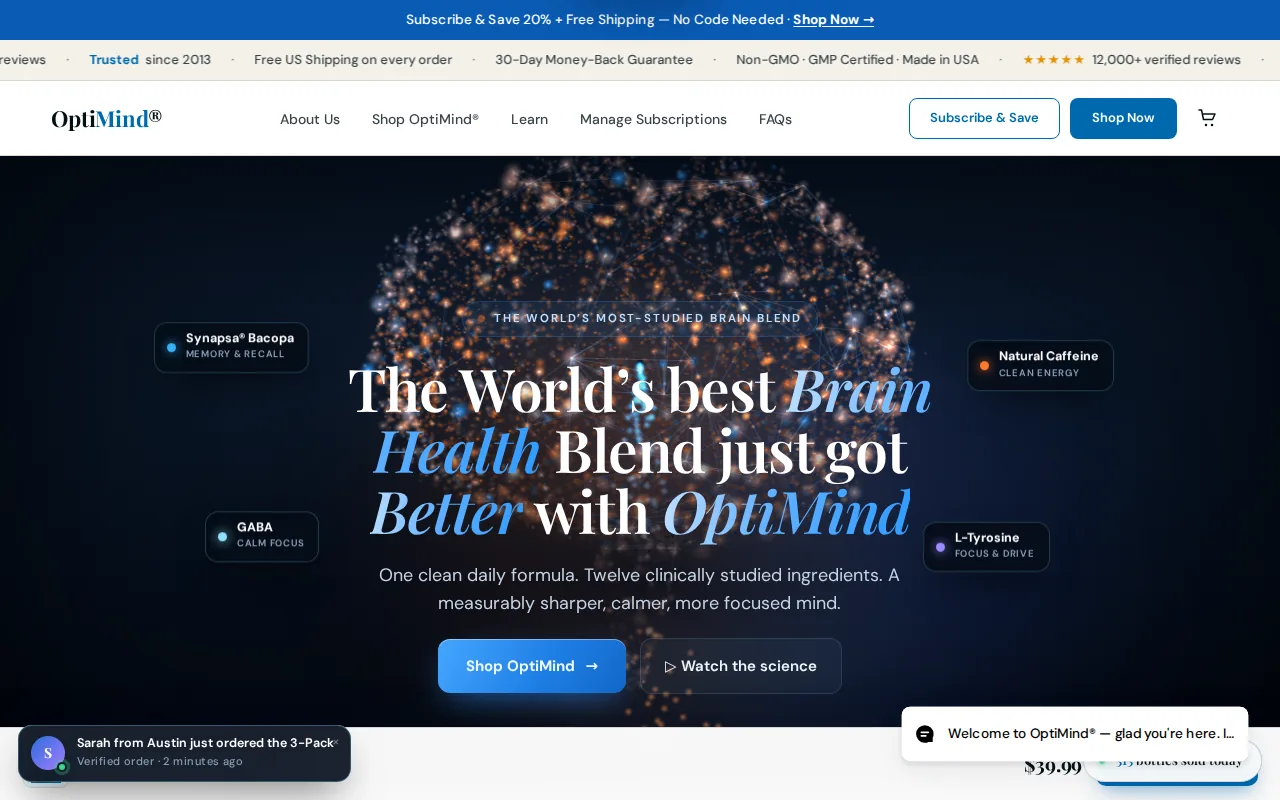
OptiMind fits the middle ground in the nootropic vs Adderall debate. Its formula uses clinically studied ingredients for focus, memory, and mental energy. The brand positions it around sharp focus and crash-free energy, rather than the rush that some users feel from amphetamine medication. Readers comparing ingredients and goals can also explore these nootropics for focus and energy.
That makes it a better match for a long work block, a study day, or a string of meetings. You can take the same product across the same workload instead of treating every hard task like an emergency.
The trade-off is clear. OptiMind won't match Adderall's strength or speed for diagnosed ADHD. A supplement also can't replace an assessment when poor focus affects school, work, sleep, or daily life.
We also like the simpler choice. Instead of building a large stack from separate bottles, you can review the formula through OptiMind's nootropic ingredients database and decide if the listed actives fit your needs.
For a ready-made option with a focus-first goal, OptiMind is the sensible starting point.
2. Caffeine, Fast Alertness and Attention Support
Caffeine is the most familiar option in the nootropic vs Adderall comparison. It is best for a quick lift in alertness when tiredness is the main problem.
Caffeine blocks adenosine receptors. Adenosine is one of the signals that builds sleep pressure, so blocking it can make you feel more awake. Typical studied amounts range between 40 and 300 mg. The effect often takes about an hour to peak and may last three to four hours.
That short window can help before an early shift or a focused writing session. It does not fix poor planning, low sleep, or a medical cause of fatigue. It mainly raises wakefulness.
The downside is easy to spot. Too much can bring jitters, anxiety, a fast heartbeat, or poor sleep. Heavy use can also build tolerance, which makes the next cup feel less useful.
Keep caffeine early enough that it won't cut into your sleep. Be careful when combining it with other stimulants. The label on a supplement may contain caffeine even when the product does not feel like coffee.
Choose caffeine when you need alertness. Choose something gentler when tension is already high.
3. L-Theanine, Calmer Focus With Less Stimulation
L-theanine is a calming amino acid often considered alongside caffeine. It suits people who want attention support without a wired feeling.
A typical studied amount is 200 mg. L-theanine may support a calmer state without causing drowsiness. It has also been linked with increased alpha-wave activity, which researchers associate with relaxed attention and creativity.
On its own, L-theanine may feel too mild for someone seeking a strong energy lift. Paired with caffeine, it can make the experience feel smoother for some people. The pair still does not equal Adderall. It has less force and less evidence for treating severe attention problems.
The best use case is a desk task that needs steady thought. Think editing, reading, planning, or a long call where nervous energy gets in the way.
Do not assume calm focus means unlimited focus. Sleep, food, and task design still set the ceiling. If you take medication or have a health condition, ask a clinician before adding supplements.
L-theanine is a good fit when the problem is overstimulation, not a lack of effort.
4. Creatine, Cognitive Support Under Stress
Creatine is best known for muscle energy, but it also appears in nootropic research. It may suit people who want support for short-term memory and reasoning during stress.
A typical studied amount is 5 g per day, with benefits including better short-term memory and reasoning, especially in vegetarians and highly stressed people.
Creatine is not a same-day substitute for Adderall. It does not create a sharp stimulant rush. Its appeal is steadier support when mental work feels harder because sleep, diet, or stress has lowered your reserve.
That makes it more useful for a demanding project than for an urgent burst of wakefulness. A student facing weeks of heavy study may think about it differently from a night-shift worker who needs to stay awake right now.
Quality matters. Use a clearly labeled product and track how you feel over time. If you have kidney disease or take medicines that affect kidney function, speak with a healthcare professional first.
Creatine belongs in the slow-and-steady group. It is a poor choice when you need an immediate jolt.
5. Bacopa Monnieri, Longer-Term Memory Support
Bacopa monnieri is a botanical aimed more at memory and information processing than at instant energy. It suits people who can wait for gradual results.
Studied amounts range between 300 and 600 mg. Reported findings include faster information processing, shorter reaction times, and better memory. Bacosides, the plant's active compounds, are thought to support signaling in the brain.
Bacopa does not work like Adderall. It is not designed to push dopamine and norepinephrine activity in the same direct way. The likely value is repeated use over time, especially when learning and recall matter more than wakefulness.
For example, someone preparing for a certification exam may care about recalling facts a week later. Someone who needs to stay awake for a late shift probably needs a different answer.
Digestive upset is a reported caveat. Start with one change at a time so you can tell whether the ingredient helps or causes trouble. Avoid making a large stack on the first day.
Bacopa is a long-game option, not a replacement for an ADHD assessment or a prescription treatment plan.
6. Rhodiola Rosea, Mental-Fatigue and Stress Support
Rhodiola rosea is an adaptogenic herb used for stress and mental fatigue. It fits people whose focus drops when pressure keeps building.
Rhodiola may improve mood, decrease burnout, and reduce mental fatigue, increasing well-being. The proposed effects involve the body's stress response, though the exact action is less clear than the dopamine and norepinephrine effects linked with Adderall.
Rhodiola may help when a long workload drains your attention. It will not turn a sleep-deprived person into a rested one. It also cannot deliver the same clinical effect as a prescribed stimulant for ADHD.
Some people find stimulating herbs uncomfortable. Watch for restlessness, a racing feeling, or worse sleep. Avoid adding rhodiola on top of several other activating products until you know how you respond.
If stress is the main cause of scattered thinking, this category makes more sense than chasing a stronger stimulant. If focus problems happen in every setting, seek a proper evaluation.
7. Panax Ginseng, Performance During Demanding Tasks
Panax ginseng is a botanical option for mental performance during stressful tasks. It may suit people who want support during demanding work without using an amphetamine.
A typical studied range is 200 to 400 mg. Reported effects include less brain fatigue and better performance on difficult mental tasks. The exact mechanism remains uncertain, so the evidence should be read with care.
Ginseng is not a direct Adderall alternative for treating ADHD. Its effects are more modest and less predictable. It may make sense during a short period of heavy mental work, but it should not become a way to ignore chronic sleep loss or burnout.
Check for interactions before use. Herbs can affect how medicines work, even when they appear mild. A pharmacist can review the full list of products you take.
The decision rule is simple: use ginseng for a measured experiment, not as permission to stack several stimulants at once.
8. Ginkgo Biloba, Memory and Processing Support
Ginkgo biloba is aimed at memory and mental processing. It is a better fit for people interested in gradual support than for anyone seeking Adderall's quick drive.
Ginkgo is therefore a cautious pick. Its timeline is slow, its effect may be small, and it does not provide a wakefulness boost. It also should not be treated as a safe add-on simply because it is a plant.
People who take blood thinners or have a bleeding disorder should ask a clinician before using it. Stop and seek advice if unusual symptoms appear.
Ginkgo belongs on a memory shortlist, not in the same strength class as prescription stimulants.
9. Modafinil, Prescription Wakefulness Support
Modafinil is a prescription wakefulness medicine, not an over-the-counter supplement. It is best known for reducing drowsiness and supporting brain function in sleep-deprived adults.
Modafinil is prescription-only and non-controlled. It may reduce fatigue and improve memory in sleep-deprived adults. It is used for certain sleep disorders, so its purpose differs from casual productivity use.
Modafinil is closer to Adderall in strength than the herbs above, but it is not the same drug. Adderall strongly raises dopamine and norepinephrine activity. Modafinil has a different and less fully understood action.
Do not buy it from an unverified seller or use someone else's tablets. A prescription lets a clinician check your health history, other medicines, sleep pattern, and reason for fatigue.
Modafinil may be worth discussing with a doctor when excessive sleepiness is the core problem. It is not a shortcut around diagnosis.
10. Piracetam, Limited-Evidence Memory Option
Piracetam is a synthetic racetam that appears in discussions about memory enhancement. It is best treated as a limited-evidence option, especially for healthy adults.
Piracetam also does not have Adderall's familiar stimulant profile. It is not a reliable answer for sleepiness, drive, or severe inattention. The lack of clear benefit makes it a weak first choice for most readers.
Legal status and product quality can vary by country. Do not assume that an online listing is tested, accurately labeled, or legal where you live.
If your goal is everyday focus, a transparent formula such as OptiMind is easier to assess than a poorly documented racetam product. Readers considering a structured combination can also review how to build a nootropic stack responsibly.
How These Options Compare With Adderall
The main nootropic vs Adderall split is strength, access, and purpose. Most nootropics are sold as supplements. Adderall is a prescription amphetamine medication used for ADHD and narcolepsy.
Adderall increases activity involving dopamine and norepinephrine in the brain. Those neurotransmitters affect attention, motivation, alertness, and cognitive control. The effect can be strong, but common problems include insomnia, dry mouth, appetite loss, and weight loss.
Adderall's documented pharmacology and approved uses also show why medical supervision matters. Higher-than-prescribed or recreational doses raise the risk of dependence and serious psychiatric or physical effects.
For healthy adults, the strongest benefit of Adderall may be wakefulness and task persistence. That does not mean it makes every kind of learning better. A person may stay at a desk longer while still studying poorly.
OTC ingredients usually make smaller claims. Caffeine may raise alertness. L-theanine may support calm attention. Bacopa may help memory over time. Those effects are less forceful, but the risk burden is usually lower when the product is correctly labeled and used as directed.
Access creates another divide. A supplement can be bought without a prescription, but that does not make it risk-free. Modafinil and Adderall need a clinician's review in the United States. Buying prescription pills outside that system adds uncertainty about both the drug and the seller.
The medical reference entry for Adderall describes both its therapeutic role and the dangers of high doses. Never share a prescription, change a prescribed dose, or stop regular stimulant treatment without speaking with the prescriber.
Quick comparison
- Fastest alertness: Caffeine or a prescribed stimulant.
- Calmer daily focus: L-theanine or a balanced formula such as OptiMind.
- Memory over time: Bacopa, creatine, or ginkgo, depending on the goal.
- Sleep-related drowsiness: Discuss modafinil with a clinician.
- Diagnosed ADHD: Get a medical assessment instead of self-treating with supplements.
Be careful with combinations. Caffeine, nicotine, prescription stimulants, and activating herbs can push alertness too far. Nicotine is especially poor as an Adderall alternative because it is addictive and can be lethal at high doses.
How to Choose Between Nootropics and Adderall
Start with the problem, not the strongest product. Ask whether you need wakefulness, calm attention, memory support, or help with symptoms that impair daily life.
- If you slept badly once, fix sleep first and consider a modest alertness aid.
- If stress makes you scattered, a calming option may fit better than a stimulant.
- If memory is the concern, give slow-acting ingredients time before judging them.
- If inattention affects work, school, driving, or relationships, arrange a clinical evaluation.
Use one new variable at a time. Track sleep, focus, mood, appetite, and unwanted effects for several days or weeks, depending on the ingredient. This gives you a better read than adding five products at once.
Check the label for exact amounts. Transparent dosing makes it easier to compare a formula with single ingredients. It also makes it easier for a clinician or pharmacist to spot possible interactions.
OptiMind is the most direct choice here for healthy adults who want a ready-made focus supplement. Review the OptiMind product details before buying, then use it consistently enough to judge your own response.
FAQ
Is nootropic better than Adderall?
A nootropic is better for some healthy adults who want mild focus support without a prescription. Adderall is generally more potent and has stronger clinical use for diagnosed ADHD, but it also carries greater stimulant risks. The right choice depends on your symptoms, health history, sleep, and medical guidance.
Can nootropics replace Adderall for ADHD?
Nootropics can't reliably replace Adderall for ADHD. Ingredients such as caffeine, bacopa, or L-theanine may support alertness or memory, but they don't have the same evidence or strength for treating significant attention symptoms. If ADHD may be affecting your life, ask a qualified clinician for an assessment.
What is the safest alternative to Adderall?
There is no single safest alternative for everyone. For mild, occasional tiredness, sleep and a modest amount of caffeine may be enough. For daily focus support, a clearly labeled product such as OptiMind may suit healthy adults. Prescription alternatives require a clinician because safety depends on your diagnosis and health history.
How fast does Adderall work compared with nootropics?
Adderall commonly begins working within about one to two hours and may last up to twelve hours, depending on the formulation and person. Caffeine often acts within about an hour and lasts three to four hours. Ingredients such as bacopa and ginkgo are slower, so they aren't useful as instant substitutes.
Can I take caffeine with Adderall?
Ask your prescriber before combining caffeine with Adderall. Both can raise stimulation, which may worsen anxiety, sleep loss, a racing heart, or other side effects. The same caution applies to nicotine and activating herbs. Don't change a prescription plan based on an online comparison.
Should I talk to a doctor before taking nootropics?
You should talk with a healthcare professional before taking nootropics if you use medication, have a health condition, are pregnant or nursing, or have severe focus problems. A pharmacist can check interactions. A doctor can also look for sleep, mood, thyroid, or other health issues that mimic poor attention.
Conclusion
For healthy adults seeking mild, crash-free focus support, OptiMind is the clearest first option in this shortlist. It won't replace prescribed treatment for ADHD or sleep disorders. Review the formula, check with a healthcare professional if you take medication, then choose the OptiMind pack that fits your routine and track how you respond.
These statements have not been evaluated by the Food and Drug Administration. This product is not intended to diagnose, treat, cure, or prevent any disease.