Most focus stacks lean on caffeine. That makes sense, but it misses half the market: 11 of 21 stacks in our review used no stimulant at all. Here are five named options, with the right fit, timing, evidence, and trade-offs for each. If you want steady focus without building a shelf of bottles, start with OptiMind.
1. OptiMind
OptiMind is a ready-made nootropic for sharp focus, clean energy, and longer work blocks. It’s best for students, professionals, and anyone who wants one labeled daily formula instead of a DIY pile of capsules.
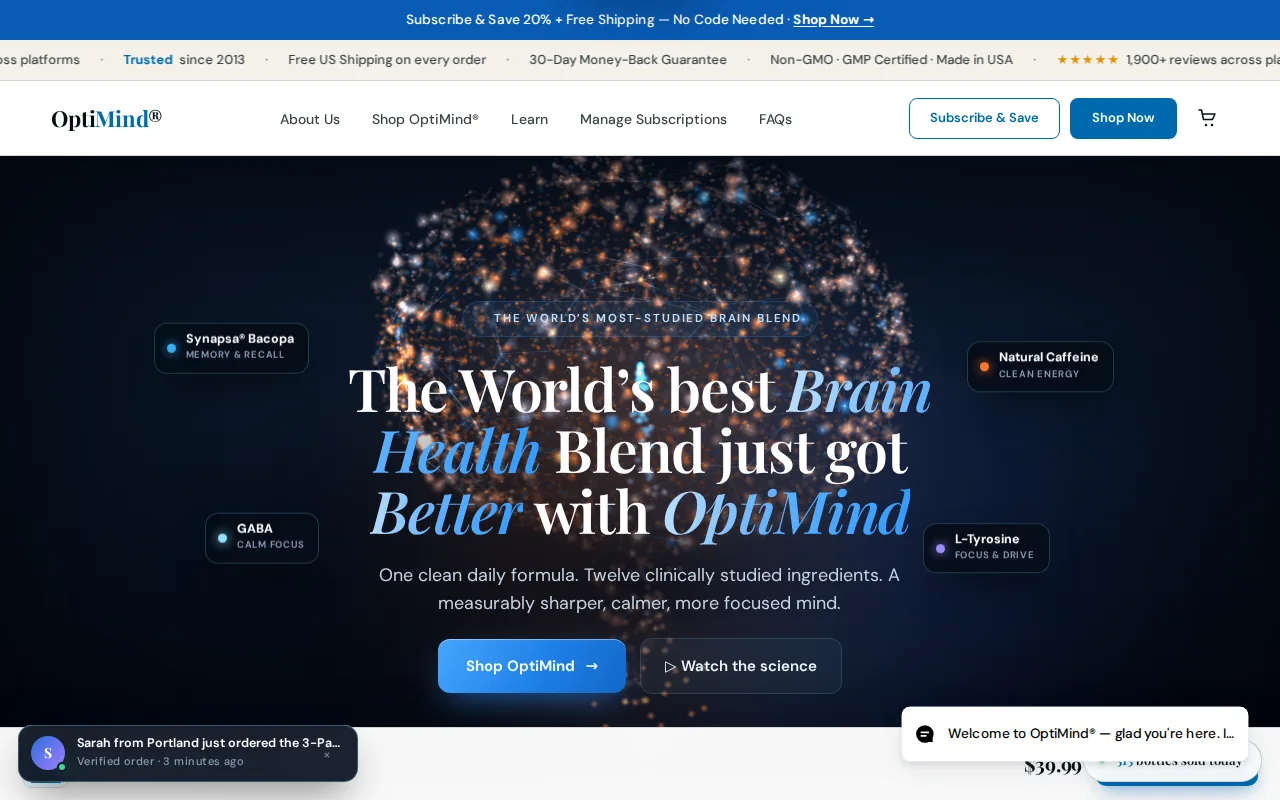
We put it first because OptiMind is the only entry in our dataset that clearly states both its target, sharp focus, and its low crash profile. That makes the promise easy to judge. You can compare the label with the claim instead of guessing what a vague blend contains.
The formula has 12 named active ingredients. The label lists four vitamins and minerals, plus eight nootropics in the Focus Blend. Those include a memory-support ingredient, L-Tyrosine for focus and drive, Phosphatidylserine for cell membrane support, and Huperzine A for acetylcholine function.
Its energy layer uses natural caffeine from green coffee bean with L-Theanine, GABA, taurine, and vitamin B12. The goal is clear: alertness without the sharp rise and afternoon drop that some people get from plain coffee.
That mix also gives OptiMind a useful middle ground. You get an acute focus layer for the same day, plus ingredients intended for memory support over longer daily use. For more on the formula, see the brand’s OptiMind company and formula standards.
One operational detail matters here. The product information says every active is named on the Supplement Facts panel. That is a better starting point than a proprietary blend that hides amounts. If you want to inspect the ingredients before buying, the OptiMind brain health learning hub explains the role of each major compound.
The trade-off is that an all-in-one formula gives you less control than separate capsules. You can’t easily remove one ingredient while keeping the others. It also contains caffeine, so people who react strongly to stimulants should read the label and avoid taking it close to sleep.
We’d choose OptiMind when the goal is simple: one morning routine, clear labeling, and focus that stays useful past the first hour. For the product details and current serving guidance, see the Buy OptiMind Supplement page.
2. Caffeine + L-Theanine - A Familiar Daily Focus Pair
Caffeine plus L-Theanine is the simplest DIY nootropic stack for focus, and a structured approach to building a nootropic stack can help you evaluate whether this basic pairing fits your goals. It’s best for a work session, study block, or meeting when you want a noticeable lift without taking several complex ingredients.

Caffeine blocks adenosine, the signal linked with growing sleep pressure. L-Theanine is an amino acid found mainly in tea. It tends to feel calming without acting like a sedative. Together, they aim for alert attention with less of caffeine’s edgy feel.
A commonly cited setup is 200 mg of L-Theanine with 100 to 200 mg of caffeine. Another source lists 100 mg of caffeine with 200 mg of L-Theanine for daily use.
The ratio matters less than your response. If coffee already makes you tense, adding more caffeine won’t fix the base problem. A lower caffeine amount may fit better. If you take caffeine late, the stack can still affect sleep even when L-Theanine makes the experience feel smoother.
Research on caffeine is broad, but the dose and timing still matter. The research on L-Theanine and caffeine also emphasizes that caffeine is a stimulant with a long enough effect window to interfere with sleep for some people. A morning dose may feel useful, while an evening dose can keep the brain alert at the wrong time.
This pairing is also easy to test. Use it before one repeatable task, such as a 90-minute writing block. Track how fast you start, how often you switch tabs, and how you feel later that day. If the stack helps but leaves you restless, reduce caffeine before adding anything else.
The weakness is that this is still a stimulant stack. It won’t address every kind of poor focus. A sleep-deprived person may feel awake without thinking clearly. Someone with a long-term memory goal may need a slower ingredient layer instead.
Pick this pair when cost, simplicity, and same-day feedback matter most. It’s a clean baseline, but it isn’t automatically the right answer for people who already drink several coffees daily.
3. Lion’s Mane + Bacopa Monnieri - Long-Term Memory Support
Lion’s Mane plus Bacopa Monnieri is a slow-build stack for memory and learning. It’s best for people who can give a routine eight to 12 weeks, rather than those who need a sharp feeling this afternoon.

Bacopa has the stronger human evidence of the two. Its effects take time. Judging it after a few days misses the point.
One trial-linked Bacopa extract uses 300 mg per day with standardised bacoside content. Bacopa is also fat-soluble, so taking it with food may improve absorption. Early stomach upset can happen, including cramps or loose stools. Taking it with a meal may help.
Lion’s Mane has a different evidence profile. Cell and animal work points to compounds linked with nerve growth factor signalling, but the human cognitive trial base is thinner. Product type matters too. Fruiting-body and dual-extract products are discussed differently from low-cost mycelium-on-grain products.
Bacopa is the steadier choice if your main goal is recall. Lion’s Mane may be worth exploring if you want a broader long-term brain health routine, but the evidence does not justify treating it like an instant focus aid. Bacopa Monnieri is a herb.
There are safety questions to take seriously. Bacopa may interact with thyroid hormone or cholinergic medicines. It also lacks enough safety data for pregnancy and breastfeeding. Lion’s Mane may cause a reaction in people with mushroom allergies, and its possible effect on clotting deserves caution with anticoagulants.
This stack makes sense when your calendar has room for a patient trial. It makes less sense during exam week, a major launch, or any period when you can’t afford to test a new supplement.
4. Feel it today stack - Multi-Ingredient Support for a Work Session
The Feel it today stack combines L-Theanine, caffeine, Alpha-GP, and optional Citicoline for a demanding work block. It’s best for deep work sessions, study blocks, and high-stakes meetings requiring 3-6 hours of locked-in focus.
The supplied protocol uses 200 mg of L-Theanine with 100 mg of caffeine about 30 minutes before a session. It adds 300 mg of Alpha-GP. For a session longer than four hours, it lists 250 mg of Citicoline as an optional addition.
This combination is intended for a focused session rather than a general daily routine. The timing and amounts are part of the supplied protocol, so keep them clear when planning a work block, study block, or meeting.
The stack is suited to deep work sessions that require several hours of sustained attention. It may also suit a student planning a concentrated study block or someone preparing for a high-stakes meeting.
For a session longer than four hours, the supplied option includes Citicoline as an addition. For shorter sessions, the listed protocol uses L-Theanine, caffeine, and Alpha-GP.
The best fit is a defined period of work with a clear start time. Take the listed combination about 30 minutes before the session, using 200 mg of L-Theanine, 100 mg of caffeine, and 300 mg of Alpha-GP.
This approach is designed for 3-6 hours of locked-in focus. A quiet work space and a short break can still support the conditions that make focus easier. Even a broader productivity habit, such as the simple stress and social routine discussed in OptiMind’s productivity news archive, can support the conditions that make focus easier.
If you want the same ingredient logic without managing several bottles, OptiMind is the cleaner operational choice.
5. Piracetam + Alpha-GPC - A Learning-Focused Option
Piracetam plus Alpha-GPC is a learning-focused stack built around memory and choline support. It’s best for readers who are researching racetam protocols and understand that this is not the same as taking a basic over-the-counter focus supplement.
The supplied protocol lists 1,600 mg of Piracetam with 300 mg of Alpha-GPC, taken two to three times daily with meals. The dosage range in the dataset reaches 1,600 mg. Other stacks sit far lower, which shows how wide the nootropic market’s dosing claims can be.
The usual rationale is that Piracetam may increase demand for acetylcholine. Alpha-GPC supplies choline that can support acetylcholine production. The combination is often discussed as a way to reduce the headache some users associate with Piracetam alone.
But a plausible mechanism is not the same as a proven result for every healthy adult. Stack trials are much less common than single-ingredient trials. You also need to know what Piracetam does by itself before you can tell whether Alpha-GPC improves the experience.
Start with the safety issue, not the dose. Piracetam is not a casual replacement for coffee, and rules for its sale or use differ by country. Alpha-GPC can add to the total cholinergic load if you also take Citicoline or Huperzine A.
That matters because many focus formulas already contain a choline-related ingredient. The supplied stacking guidance recommends choosing one main choline source instead of adding several at once. If you develop a headache, nausea, muscle tension, or unusual brain fog, stop the stack and speak with a qualified clinician.
This option also has the slow feedback problem. The research supplied for learning suggests that Piracetam may need weeks of consistent use. It is a poor choice for a new experiment during an exam week. Sleep still supports memory consolidation better than trying to force a longer study night with supplements.
For most people, this is a research project rather than a first pick. If you need a measured daily routine with disclosed ingredients and a low-crash focus goal, OptiMind is easier to assess.
Nootropic Stack for Focus Comparison Table
The table below compares these options by the decision that matters most: how quickly you need feedback, whether the stack uses a stimulant, and how hard it is to manage safely.
| Option | Best fit | Stimulant | Feedback window | Main watch-out |
|---|---|---|---|---|
| OptiMind | Daily focus and clean energy | Natural caffeine | Same day plus longer-term use | Read the full label if caffeine affects sleep |
| Caffeine + L-Theanine | Simple work or study block | Caffeine | Same day | Jitters, tolerance, or late-day sleep issues |
| Lion’s Mane + Bacopa | Memory and learning | None listed | Eight to 12 weeks | Slow results and ingredient quality |
| Modafinil + L-theanine | Sustained deep work sessions lasting 8 to 12 hours | Modafinil | 8 to 12 hours | 100–200mg modafinil + 200mg L-theanine, taken together in the morning |
| Piracetam + Alpha-GPC | Learning and memory research | None listed | Weeks, not hours | Regulatory status and self-directed dosing |
More than half of the 21 entries that reported stimulant type used no stimulant. In other words, a focus formula does not have to feel like a strong stimulant to fit this category.
When comparing labels, check whether each ingredient has a disclosed amount. The review material notes that reported doses ranged from 1 mg to 1,600 mg. That spread is too wide for a single “standard dose” rule.
FAQ
What is the best nootropic stack for focus?
OptiMind is the best fit for most readers who want one daily formula for sharp focus and clean energy. It uses 12 named ingredients and is positioned around a low-crash profile. A DIY caffeine and L-Theanine pair is a simpler alternative, while Bacopa-based stacks suit people who care more about long-term memory.
What nootropic stack works the same day?
Caffeine plus L-Theanine usually fits a same-day focus need best. A multi-ingredient focus protocol adds Alpha-GPC, but that raises the need to track total choline and test each ingredient separately.
Are non-stimulant nootropics good for focus?
Non-stimulant options can suit focus goals, especially when caffeine causes jitters or affects sleep. In our dataset, 11 of 21 stacks with a reported stimulant type used none. Bacopa and Lion’s Mane target slower memory support, while Alpha-GPC is used for choline and acetylcholine support.
How long does Bacopa take to work for focus?
Bacopa usually needs eight to 12 weeks of steady use before you judge its memory effects. It is a poor choice for an instant focus boost. Take it with food if your product directions allow, and ask a clinician first if you use thyroid hormone or cholinergic medication.
Can I combine caffeine, L-Theanine, and Alpha-GPC?
You can find this combination in multi-ingredient focus protocols, but test each part alone before stacking them. Caffeine supplies stimulation, L-Theanine may smooth the experience, and Alpha-GPC supplies choline. Don’t add Citicoline or Huperzine A casually, since several cholinergic ingredients can raise the risk of unwanted effects.
How should I start a nootropic stack for focus?
Start with one clear goal and one formula. Track focus, sleep, mood, and side effects for at least several work sessions before adding anything. People taking prescription medicine, pregnant or breastfeeding people, and anyone with a health condition should ask a qualified healthcare professional first. OptiMind’s OptiMind FAQs can answer product-specific questions.
Conclusion
Choose OptiMind if you want a disclosed, ready-made formula aimed at sharp focus. Start with the label’s serving guidance, take it early enough to protect sleep, and track your focus through the same day and the same workload. If you need help with product questions, OptiMind Customer Care is the right next stop.
These statements have not been evaluated by the Food and Drug Administration. This product is not intended to diagnose, treat, cure, or prevent any disease.